
Deposit invoices: how to get paid before the job is finished
How to write a deposit invoice, when VAT is due on it, how the final invoice deducts it without charging VAT twice, and when progress invoices or a monthly retainer fit better, shown with real buezli.app screens.
Updated October 9, 2026 7 minute read
A ten-week project that is paid at the end means you finance ten weeks of work for your client. Asking for part of the money upfront fixes that, and it also tells you early whether the client is serious.
There are three common ways to do it:
| What it is | Good for | |
|---|---|---|
| Deposit | Part of an agreed price, paid before the work starts | Fixed-price projects |
| Progress invoices | Invoices for the work done so far, for example monthly | Long projects billed by the hour |
| Retainer | A fixed amount every month for ongoing work | Support, maintenance, ongoing advice |
This article walks through a deposit from start to finish, with buezli.app screens and example data: a web studio builds an online shop for a café for €10,000 plus 19 % VAT and asks for 30 % upfront. Progress invoices and retainers follow at the end.
Start from an accepted estimate
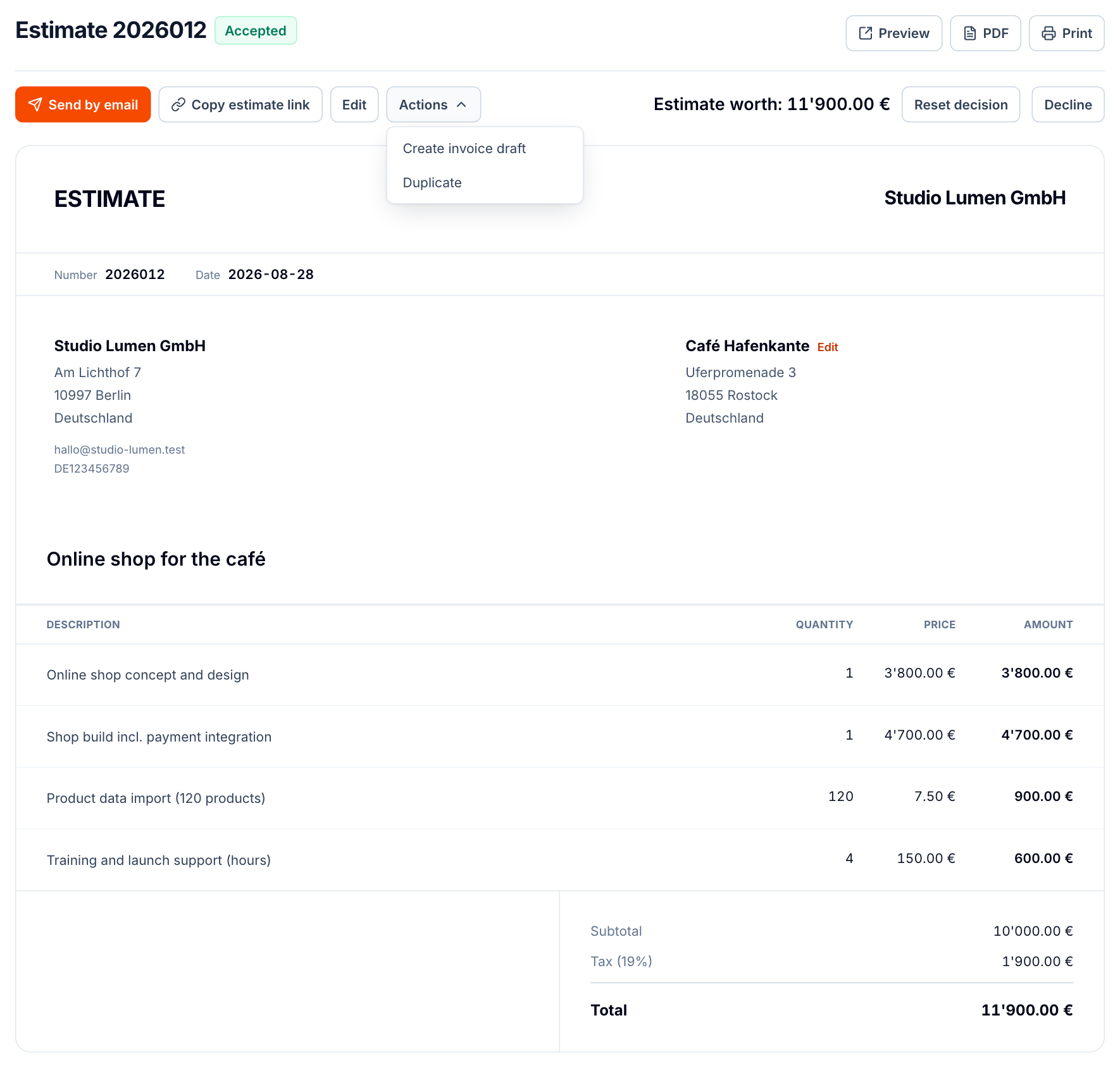
A deposit only makes sense for an agreed job. Put the price and the deposit terms in the estimate or contract, for example: "30 % on acceptance, the rest on delivery". In the example, the café accepted the estimate through its online link, so the price and scope are on record.
The deposit invoice
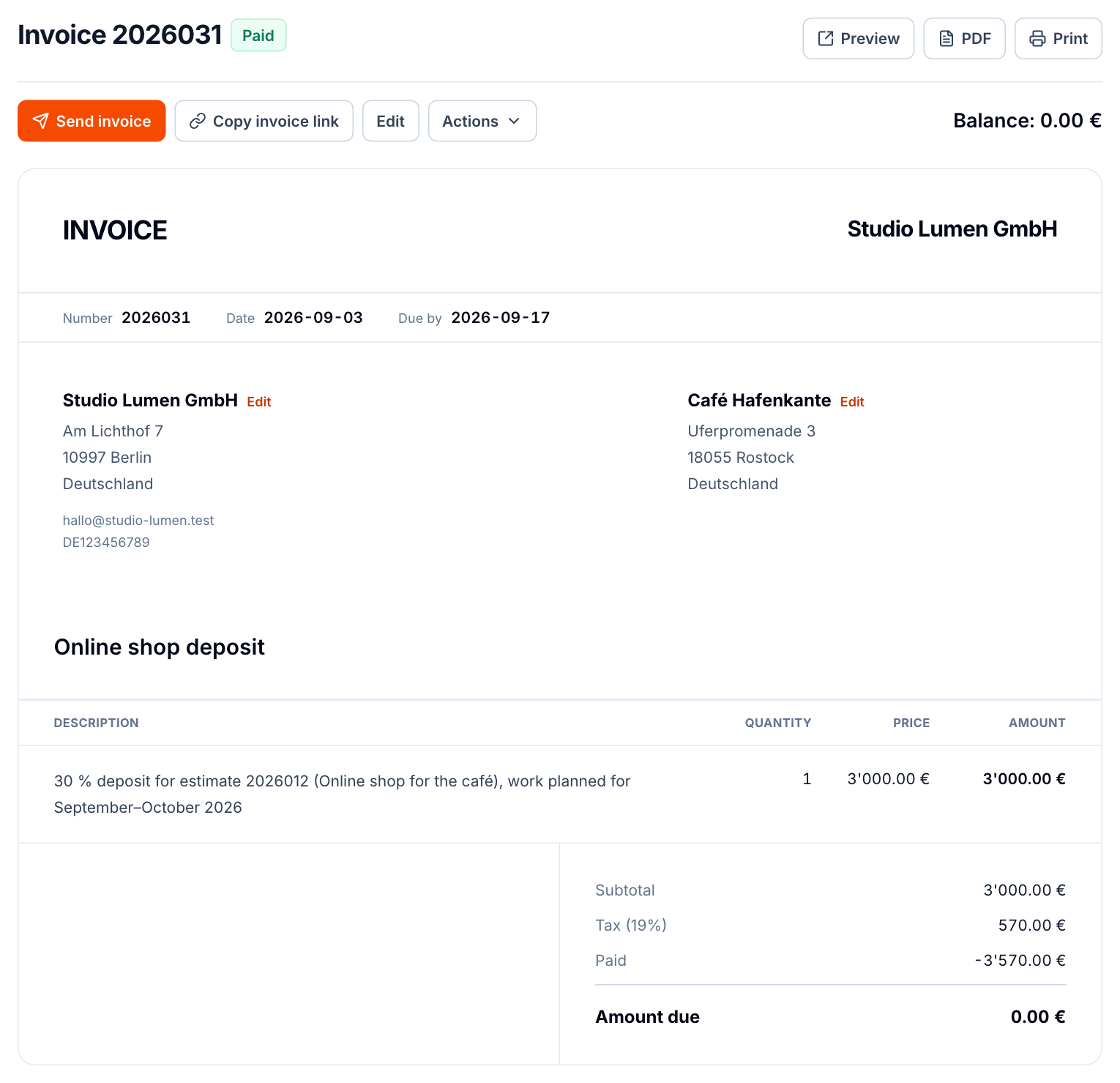
A deposit invoice is a normal invoice with one line. Make it obvious what it is:
- call it a deposit, and name the estimate or contract it belongs to;
- describe the work and when it is planned;
- show the deposit amount, the VAT rate and the VAT on it.
In the example that is "30 % deposit for estimate 2026012 (Online shop for the café), work planned for September–October 2026": €3,000 plus €570 VAT, €3,570 in total.
buezli.app has no special deposit invoice type. You write it like any other invoice, which also means it gets a normal invoice number, PDF, online link and payment record.
When VAT is due on a deposit
For services, most countries tax a deposit when it is paid, not when the work is finished:
- Germany and Austria: VAT on a deposit is due for the period in which you receive the money.
- Switzerland: prepayments are taxed when received, also if you normally account on invoices issued.
- France: VAT on services is due when payment is received, unless you opted to pay on invoices (débits).
- Italy: the invoice or the payment, whichever comes first, triggers the VAT.
- United Kingdom: the tax point is the earlier of the VAT invoice and the payment.
So if the café pays the deposit in September, the €570 belongs in your September VAT return, even though the shop launches in October.
The final invoice deducts the deposit
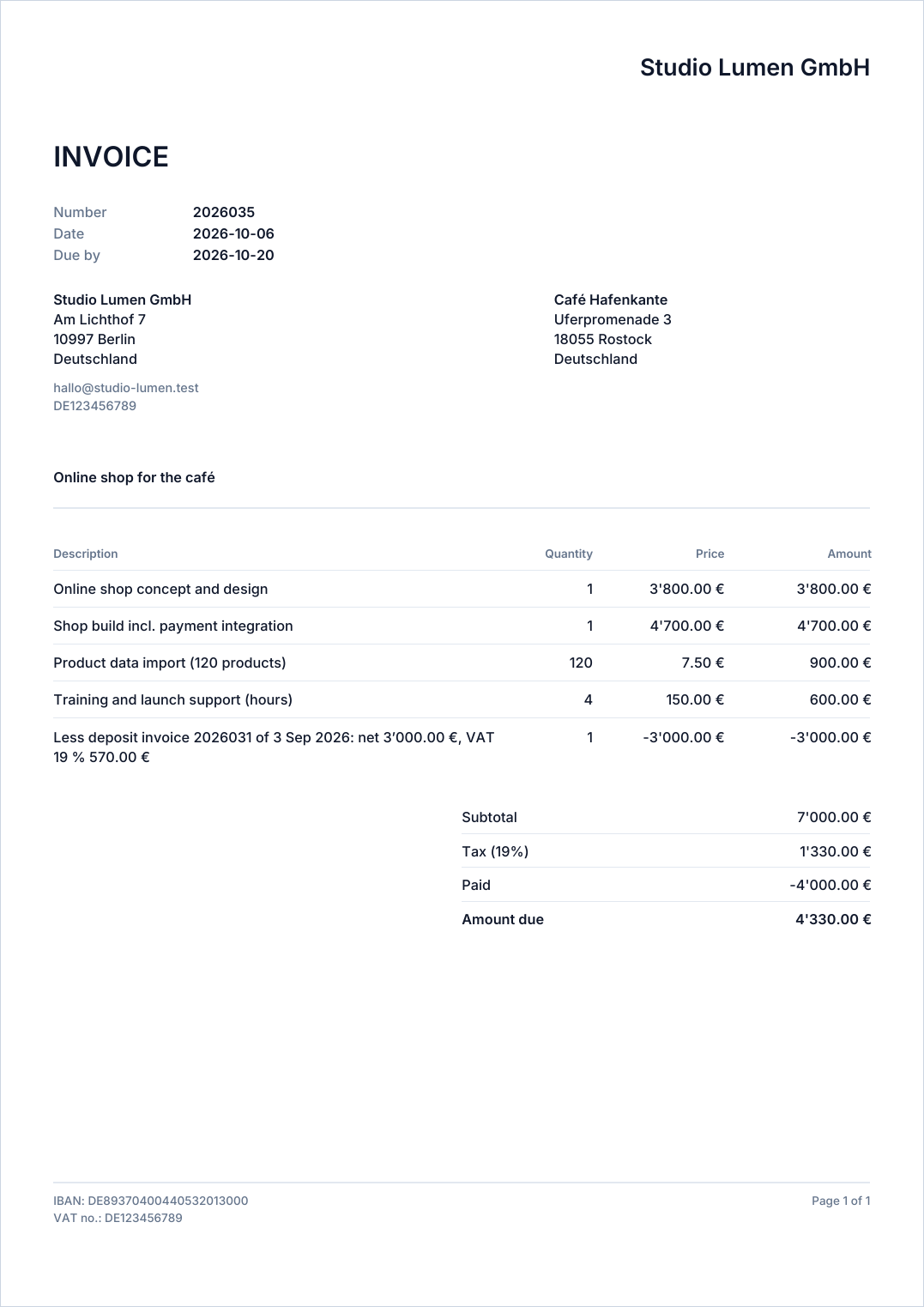
When the work is done, the final invoice covers the whole job and subtracts what was already invoiced:
| Net | VAT 19 % | Total | |
|---|---|---|---|
| Whole job | €10,000.00 | €1,900.00 | €11,900.00 |
| Less deposit invoice | −€3,000.00 | −€570.00 | −€3,570.00 |
| Still to pay | €7,000.00 | €1,330.00 | €8,330.00 |
The important part is the VAT. If the final invoice charged €1,900 VAT on the full price without deducting the €570 from the deposit invoice, you would have shown €570 too much VAT. In Germany you then owe that amount twice until you correct the invoice. The client may only deduct the VAT on the remaining amount.
In buezli.app the final invoice comes from the estimate: "Create invoice draft" copies all estimate lines. Then add one line with a negative amount, "Less deposit invoice 2026031 of 3 Sep 2026", at −€3,000 and the same VAT rate. buezli.app calculates the VAT on what is left. Write the deposit's net amount and VAT into that line, as in the example, so both are visible on the final invoice.
Partial payments on the final invoice
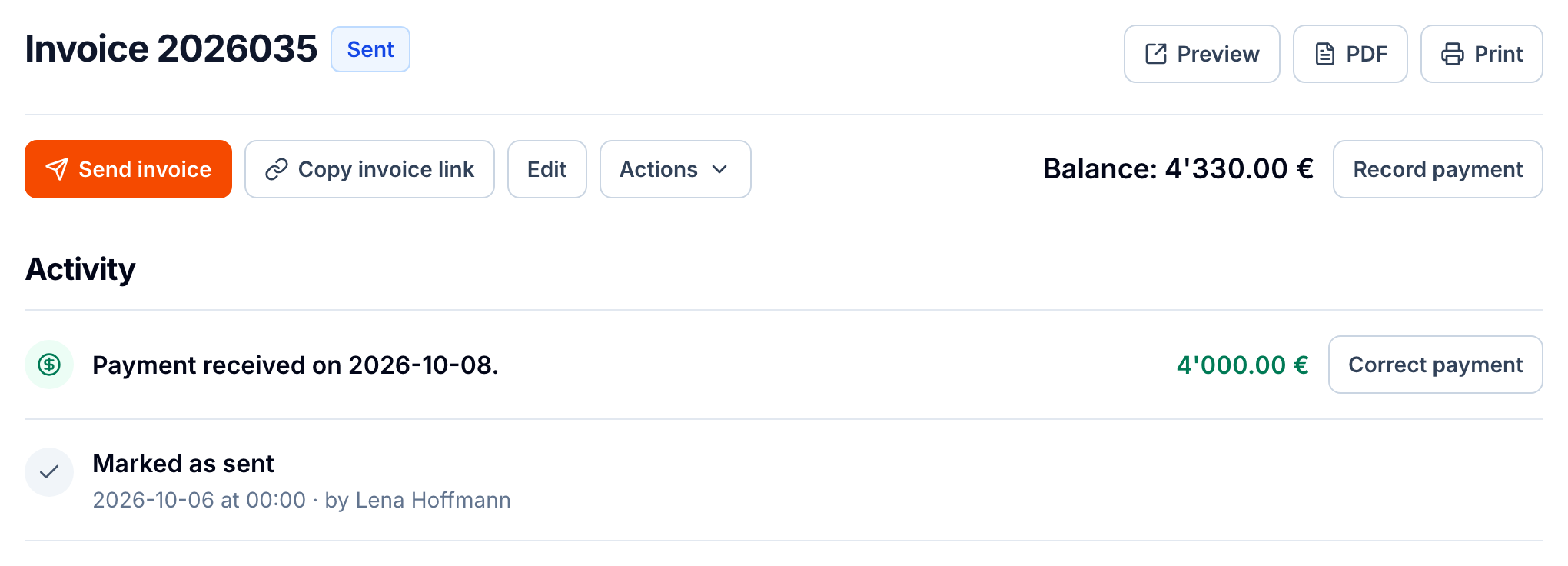
Clients do not always pay the rest in one go. In the example the café paid €4,000 of the €8,330. buezli.app records each payment separately and shows the open balance, so the next PDF and the online invoice show the right amount.
Progress invoices for work billed by the hour
A deposit fits a fixed price. If you bill by the hour, you do not need one: invoice the hours already worked every month instead. The uninvoiced work report in buezli.app lists every billable hour that is not on an invoice yet. Our article on billable hours shows how that becomes an invoice.
Retainers for ongoing work
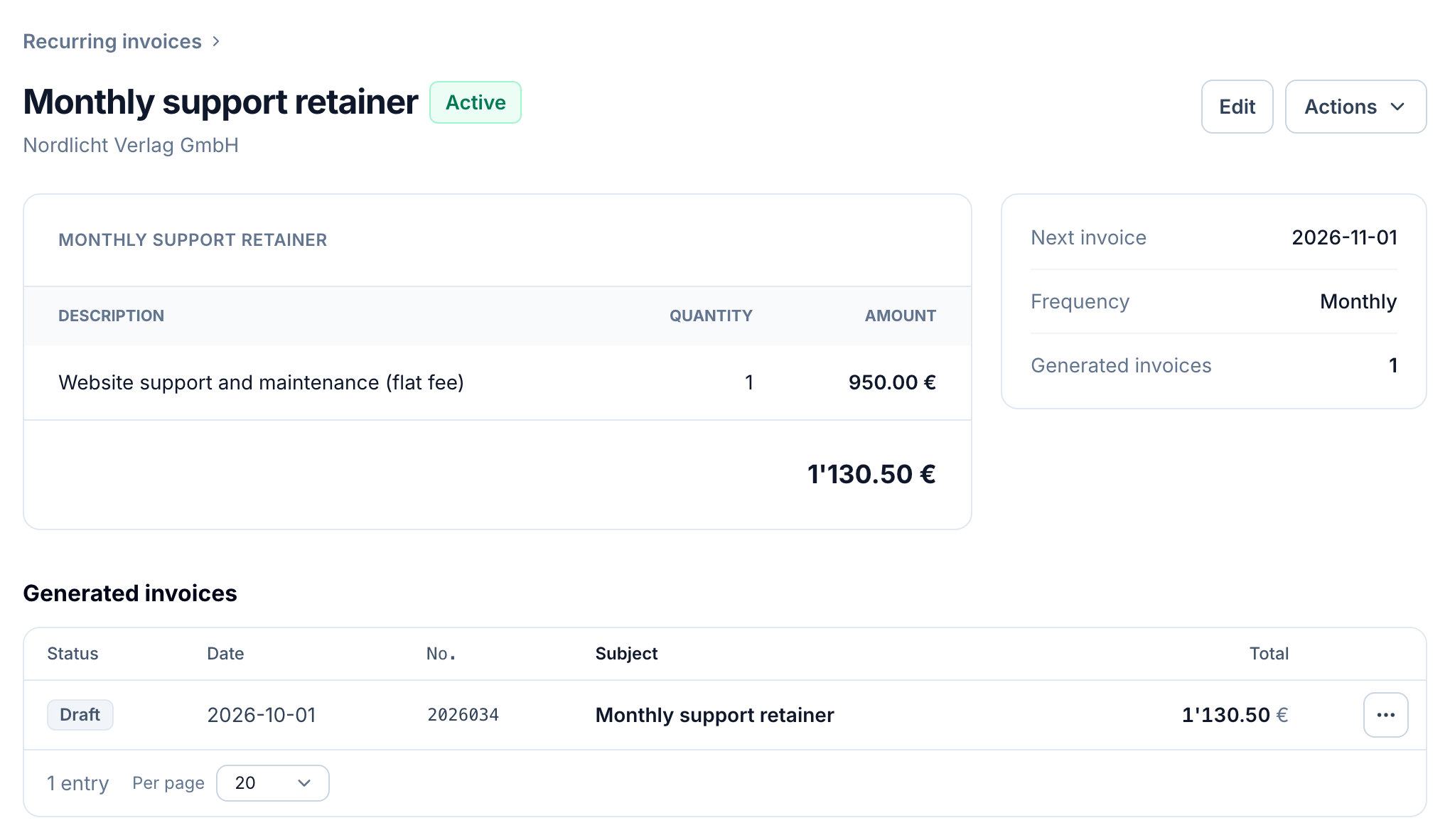
A retainer is not a deposit. It pays for ongoing work or availability, for example website support, and nothing is deducted later. In buezli.app you set it up once as a recurring invoice: amount, client and schedule. A new invoice is created on each date, ready for you to check and send.
Checklist for deposits
Limits of this article
This is general information, not tax advice. Deposits for goods, construction work, cancelled projects and refunded deposits can follow other rules. Check your case with a tax adviser or your tax office.
Sources
German VAT Act § 13 and § 14 and VAT application decree 14.8, Austrian VAT Act § 19, Swiss VAT Act Art. 40, BOFiP on deposits, DPR 633/72 art. 6 and HMRC on deposits.