
Invoicing international clients: language, VAT notes and currency
Whether you may invoice in English, which VAT note a cross-border invoice needs inside and outside the EU, how to handle a foreign currency, and how to set a client's language and currency once, shown with real buezli.app screens.
Updated October 9, 2026 7 minute read
Your first client abroad usually raises three questions at once: may the invoice be in English, does it carry VAT, and in which currency? For business clients and services, the answers are simpler than they look.
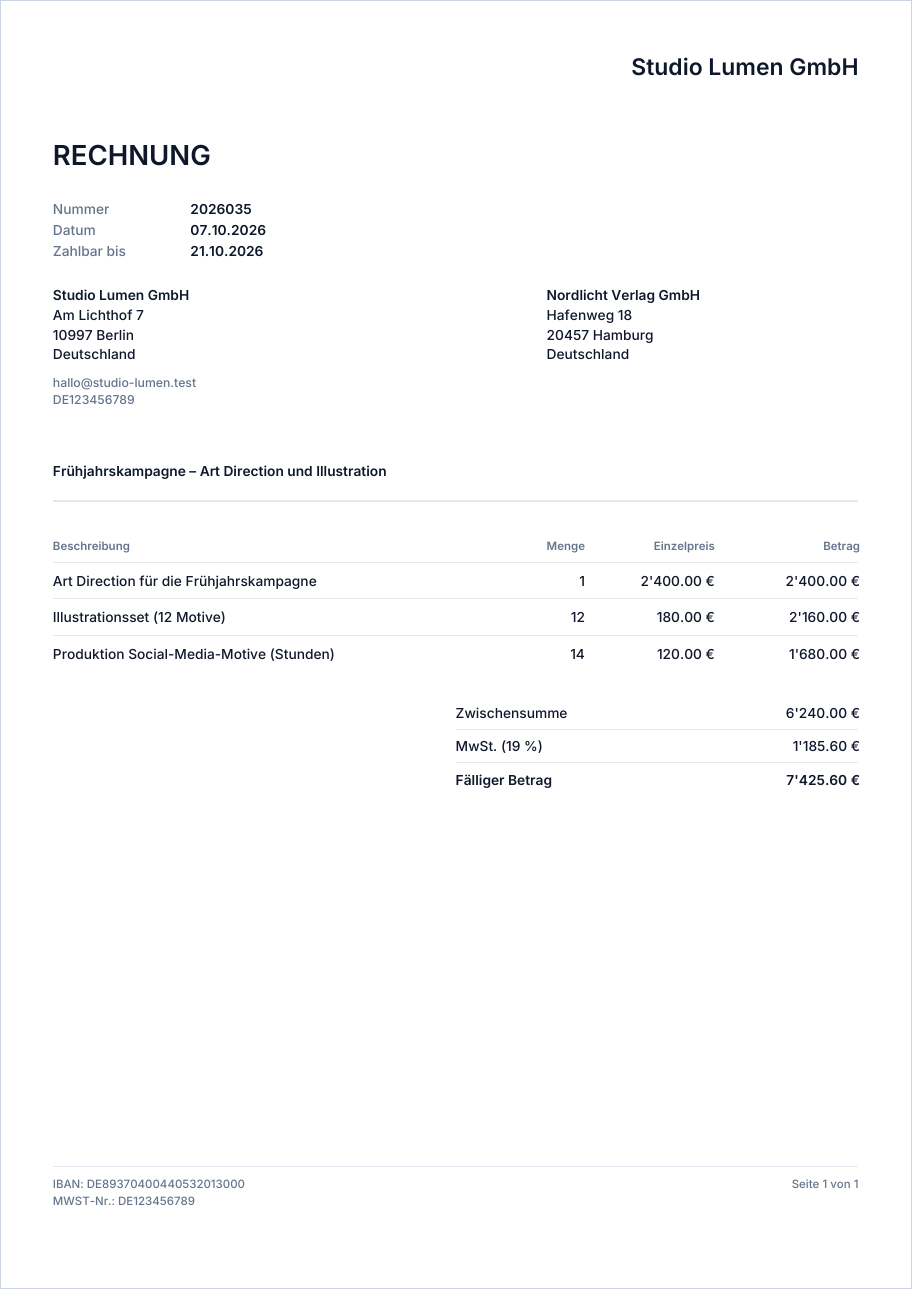
The screenshots show buezli.app with example data: a design studio in Berlin invoices a studio in Amsterdam and a company in Portland, Oregon.
May the invoice be in English?
In most of Europe, yes. EU VAT rules do not prescribe an invoice language. Germany, France and Italy accept invoices in English; the tax office can ask for a translation of a specific invoice during an audit.
Two exceptions are worth knowing:
- Belgium: businesses based in Flanders must issue invoices in Dutch. They may add a version in another EU language for clients in another EU country, but the Dutch one prevails.
- Italy: you can send your foreign client an English PDF, but the invoice data must still go to the tax authority's exchange system (SdI) as an XML file.
Swiss VAT guidance lists what an invoice must contain but sets no language.
Set the language once per client
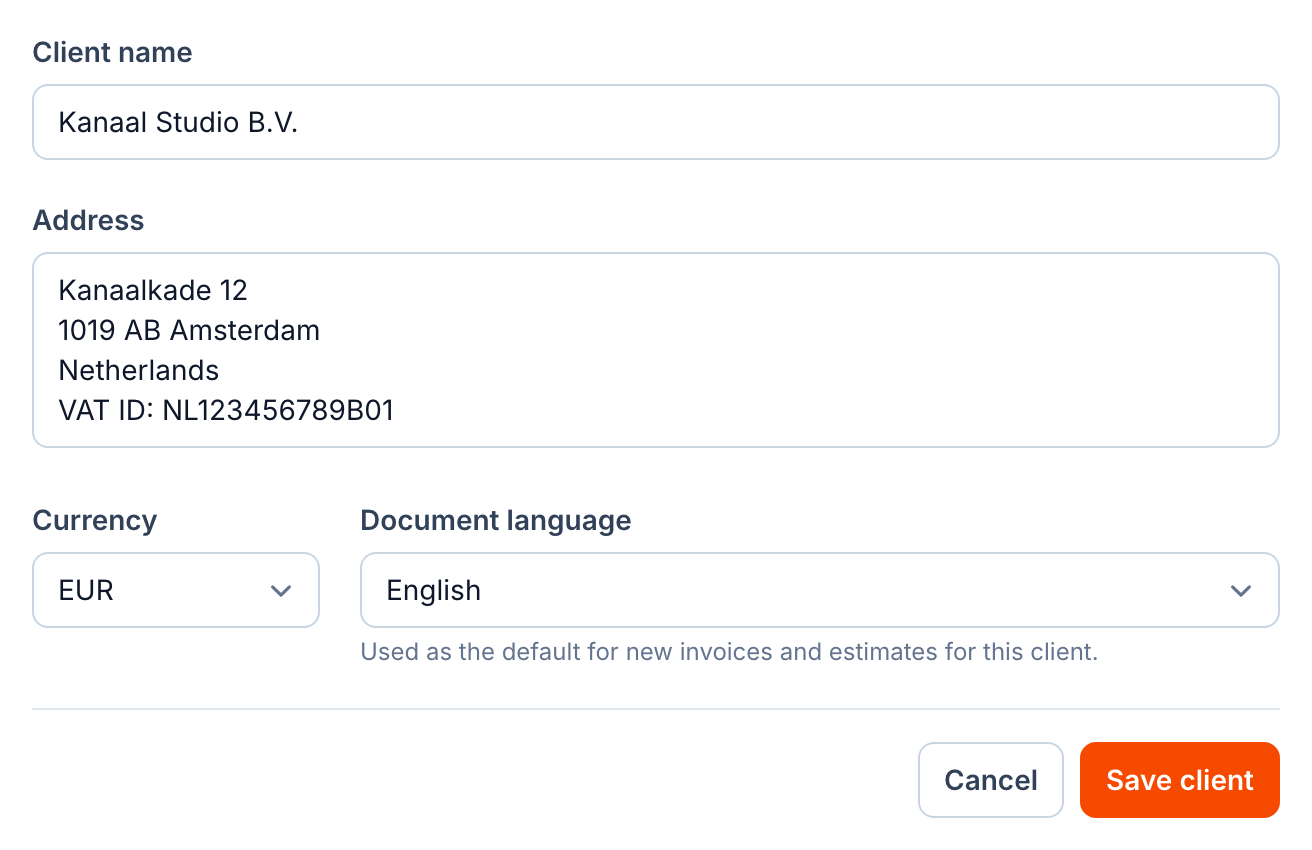
In buezli.app each client has a currency and a document language. New invoices and estimates for that client start in that language, so the headings, labels and dates on the PDF are in English without you thinking about it. Your own line texts are not translated, so write them in English too.
VAT on services to business clients in the EU
For services to a business in another EU country, the client pays the VAT in their own country. This is called reverse charge. Your invoice then:
- shows no VAT, so the rate is 0 %;
- says that the client owes the VAT;
- shows your VAT ID and the client's VAT ID.
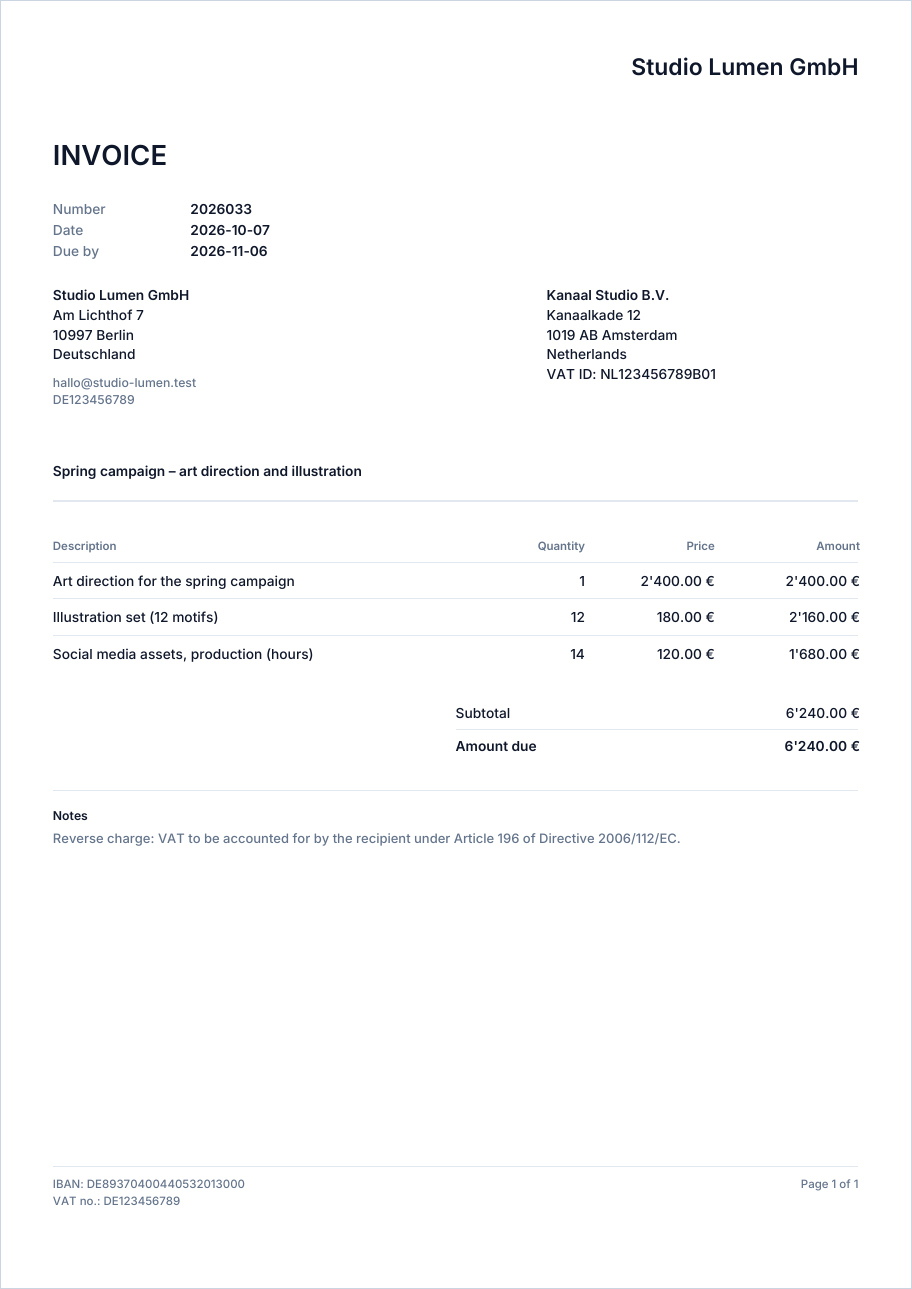
The note itself depends on where you are based. The EU wording is "Reverse charge", and these national versions are common:
| Your country | Note on the invoice |
|---|---|
| Germany | "Steuerschuldnerschaft des Leistungsempfängers", or "Reverse charge" (accepted since September 2025) |
| Austria | A note that the tax liability passes to the client; no fixed wording |
| France and Belgium | "Autoliquidation" |
| Italy | "Inversione contabile" |
You also report these services in a recapitulative statement: in Germany the Zusammenfassende Meldung, in Austria the ZM, in France the déclaration européenne de services.
Clients outside the EU
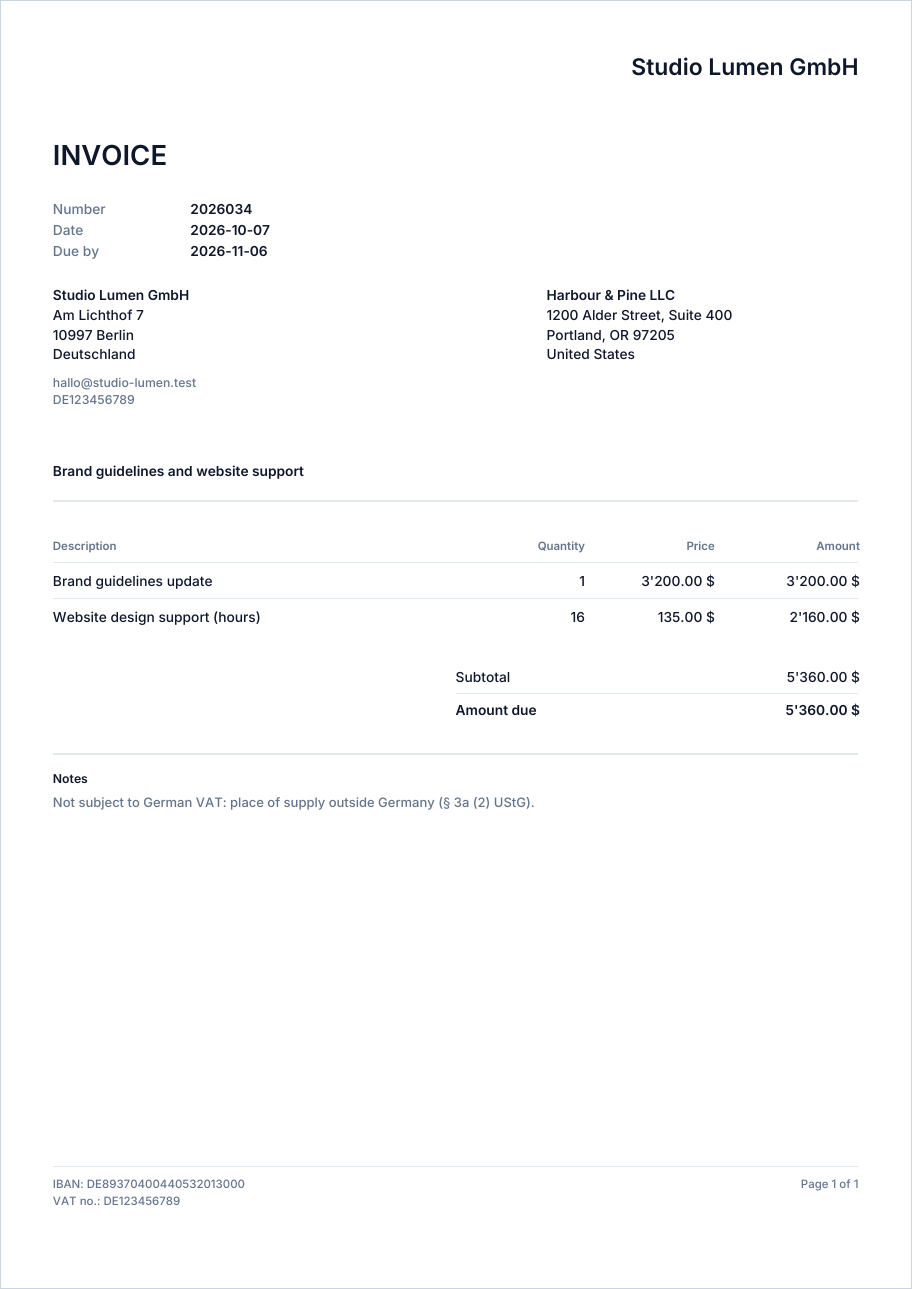
For most business services to a client outside the EU, the place of supply is the client's country, so you charge no VAT in your own country. There is no EU reverse charge wording for this. Add a short note anyway so your accountant and the tax office can see why VAT is missing, for example "Not subject to German VAT: place of supply outside Germany". France prescribes "TVA non applicable – art. 259-1 du CGI", Italy "operazione non soggetta".
Swiss businesses invoicing abroad
A Swiss business that provides services to a business abroad generally charges no Swiss VAT, because the service counts as supplied where the client is based (Article 8 of the VAT Act). Keep the client's name, address and seat on the invoice and describe the service clearly; that is your proof. Do not show Swiss VAT by mistake: any VAT on an invoice is owed.
How to set it up in buezli.app
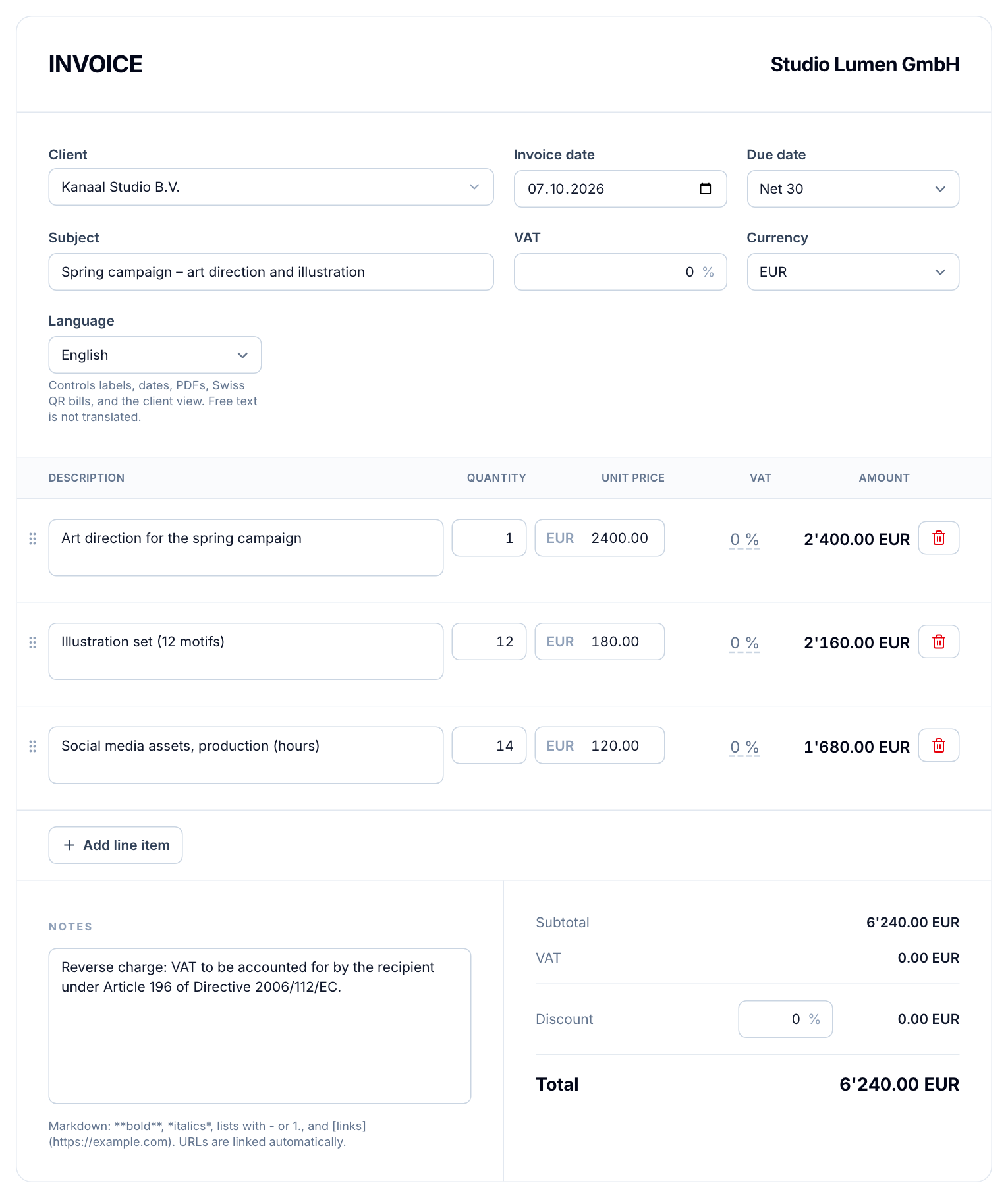
- Client VAT ID: add it as the last line of the client's address, for example "VAT ID: NL123456789B01". It prints with the address.
- Your VAT ID: set it once in your account; it prints under your address and in the footer.
- VAT rate: set the invoice's VAT rate to 0 %. The PDF then shows no VAT line, which is why the note matters.
- The note: write the reverse charge or "not subject to VAT" note in the invoice notes. Notes carry over when you convert an estimate.
- Service period: EU invoices need the date or period of the service if it differs from the invoice date. Put it in the subject or the notes.
- BIC/SWIFT: buezli.app prints your IBAN in the footer. Clients paying from outside the SEPA area, for example in the US, also need your BIC; add it to the notes.
Currency
You can invoice a foreign client in their currency. buezli.app supports CHF, EUR and USD per client and per invoice. If an invoice in a foreign currency shows VAT, the VAT must also be converted into your national currency for your return: in Germany at the monthly average rate published by the finance ministry, in Switzerland at the ESTV monthly rate or the daily rate. Reverse charge invoices show no VAT, so this mostly matters for domestic invoices in a foreign currency.
Checklist for an invoice abroad
Limits of this article
This is general information about services between businesses, not tax advice. Sales to consumers, goods, events, real estate and digital services to private customers follow different rules. Check your case with a tax adviser or your tax office.
Sources
EU Commission explanatory notes on invoicing, German Fiscal Code § 87, German VAT Act § 14a, BMF letter of 17 September 2025, Austrian business service portal, French invoice mentions, Flemish language decree, Agenzia delle Entrate on cross-border invoices, ESTV MWST-Info 06.